19 August 2026
AI in Post-Trade Execution: Useful Tool or Industry Buzzword?
Every few months, there’s a new headline declaring that AI is transforming another industry. Commodity trade is no exception.
But beyond the headlines and product launches, a more practical question remains:
Where is AI actually making a difference?
For most trading companies, the answer isn’t in replacing traders or making commercial decisions. It’s in removing the repetitive, document-heavy work that slows down post-trade execution every day.
From drafting shipping documents to checking them against Documentary Instructions (DIs), Letters of Credit (LCs) and buyer requirements, AI is beginning to solve problems that operations teams have lived with for decades.
That’s where the real value lies.
The hidden cost of manual documentation
Commodity trading generates an enormous amount of documentation. Bills of Lading, certificates, invoices, packing lists, inspection reports, Documentary Instructions and Letters of Credit all need to align, not only with each other, but also with the buyer’s specific requirements.
It only takes one discrepancy to delay the process.
According to the ICC Academy, between 65% and 75% of documentary credit presentations are refused on first presentation due to discrepancies. The most common issues include conflicting data, missing documents, incorrect goods descriptions, missing endorsements and late presentation. While many discrepancies are eventually resolved, they often result in additional reviews, amendments, delays and unnecessary operational effort.
For operations teams, this is where AI is beginning to have the greatest impact, not by replacing expertise, but by reducing repetitive, rules-based work.
Where AI receives attention and where operations teams still spend their time
Commodity trading’s AI investment has followed a familiar pattern: market intelligence and forecasting, trading execution, risk modelling, portfolio optimisation, and analytics — the visible, front-office side of the business. That’s where the case studies and the budget have concentrated. Meanwhile, on the post-trade side, operations teams are still spending their time on something far less visible but just as costly.
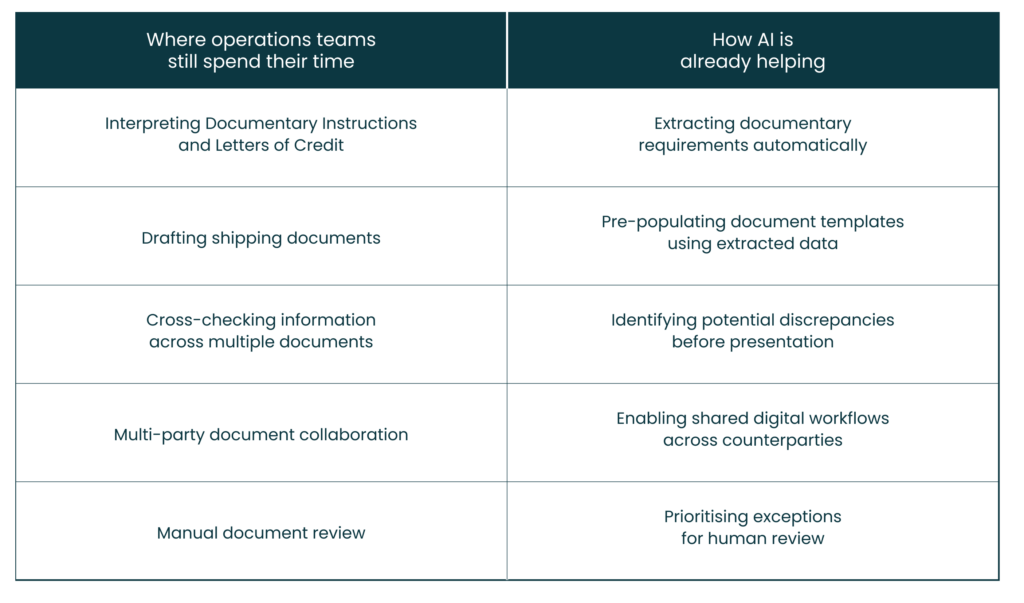
The contrast is telling. While much of the discussion around AI focuses on commercial decision-making, many of the biggest operational gains are being achieved much later in the trade lifecycle, where documentation, collaboration and compliance determine whether a transaction progresses smoothly.
AI works best where the rules already exist
Unlike generative AI writing emails or presentations, post-trade documentation follows clear business rules.
A Documentary Instruction specifies what should appear in each document. A Letter of Credit defines exactly what needs to be presented. Buyer instructions leave little room for interpretation.
That structure makes these workflows particularly well suited to AI.
Instead of asking people to read dozens of pages and manually compare information across multiple documents, AI can extract requirements, organise information and highlight potential discrepancies in seconds, allowing operations teams to focus on reviewing exceptions rather than searching for them.
The result is greater consistency, better visibility and more time spent on higher-value work.
From document creation to document checking
AI is already creating value across two key stages of post-trade execution.
Document creation
The first stage is creating the documents themselves.
AI is particularly effective here because the information already exists.
Documentary Instructions and Letters of Credit contain the requirements needed to prepare shipping documents. Instead of asking users to manually interpret those instructions and transfer information into multiple templates, AI can identify the relevant documentary requirements and structure them automatically.
This is the approach behind DocCreate.
Users upload one or more Documentary Instructions or Letters of Credit, and DocCreate uses AI to extract the documentary requirements, identify the relevant information and pre-populate document templates with the extracted data. Teams can then review, edit and generate document drafts while maintaining full control over the final output.
The workflow extends beyond drafting. Preparing shipping documents is rarely the responsibility of one organisation alone. Traders, operators, surveyors, agents, fumigators, chambers of commerce and other third parties all contribute information throughout the process. Instead of exchanging multiple document versions by email, DocCreate enables every stakeholder to collaborate within a shared digital workflow, improving visibility, reducing version control issues and simplifying document preparation from start to finish.
According to Covantis customer results, organisations using DocCreate have reported up to two days saved in the payment cycle through faster document preparation
Document checking
Creating documents is only one part of the process.
Before presentation, documents still need to be checked against Documentary Instructions, Letters of Credit and buyer requirements to ensure they are complete, consistent and compliant.
This review process is repetitive, detail-oriented and often carried out under tight deadlines.
That’s where QuickDocs comes in.
Rather than deciding whether documents are compliant, QuickDocs performs the repetitive comparison work that traditionally consumes so much time. It extracts information from shipping documents, compares it against Documentary Instructions, Letters of Credit and buyer requirements, and flags potential discrepancies for review.
Experienced document specialists remain in control. They review the AI findings, determine whether a discrepancy is genuine and make the final compliance decision before presentation.
This human-in-the-loop approach reflects the direction of the industry more broadly. Academic research on AI-assisted Letter of Credit examination concluded that the most effective model combines AI with human expertise, using AI to accelerate document analysis and identify potential discrepancies, while leaving compliance decisions to experienced professionals. This hybrid approach improves efficiency without removing the judgement that complex trade documentation still requires.
Adoption matters more than hype
Every new technology generates excitement. AI is no exception.
The difference is that excitement doesn’t sustain adoption. Once the headlines fade, only the solutions that solve real operational problems remain.
That’s why operations teams don’t continue using technology because it’s fashionable. They continue using it because it saves time, improves consistency and makes their work easier.
In post-trade execution, that’s exactly where AI is beginning to make a measurable difference.
Today, AI is helping teams:
- Draft shipping documents faster.
- Extract information automatically from Documentary Instructions/Letters of Credit.
- Pre-populate document templates with the right information.
- Check documents consistently against buyer requirements.
- Detect discrepancies before presentation and speed-up the presentation process
Individually, these may seem like incremental improvements.
Across thousands or even tens of thousands of documents every year, they become meaningful operational gains.
Looking ahead
AI won’t eliminate the complexity of post-trade execution. Commodity trading will always involve multiple counterparties, evolving buyer requirements and complex documentary obligations.
What is changing is how that complexity is managed. As the industry continues to digitise, the organisations seeing the greatest value from AI are not replacing expertise, they’re giving their teams better tools to apply it.
At Covantis, AI is part of the direction we’re focused on. Today, AI is helping streamline document creation and document checking, but we see far greater potential across the post-trade execution lifecycle. From intelligent automation to AI copilots that support operational teams, and ultimately more agentic AI capable of coordinating complex trade execution workflows, we’re building towards a future where technology doesn’t just digitise processes, it actively helps move them forward.
We’ll be sharing more about that journey in future editions of Beyond the Inbox.
In post-trade execution, AI is already moving beyond the buzzword, and we’re just getting started.