Press release
Geneva, 17 November 2025 – Covantis has reached a major milestone in the digitalization of global agricultural trade, with over 5 million metric tons of grains and oilseeds transported on 80 vessels using its electronic Bill of Lading (eB/L) solution in the first ten months since launch. In a further breakthrough, Covantis, together with Rabobank, Louis Dreyfus Company, and COFCO International, completed the industry’s first fully digital Cash Against Documents Custody transaction, marking a key step toward paperless agri trade.
While other commodities such as energy, metals, and container shipping have advanced rapidly in adopting electronic Bills of Lading, agriculture is still in the early stages of this transition, with eB/Ls representing just 1 to 3 percent of global trade. Covantis eB/L solution, powered by Secro, is designed to close this gap by enabling the secure issuance, transfer, and presentation of digital Bills of Lading across the agri value chain.
Since launch, 75 trading legal entities have joined the platform, including ADM, Bunge, Cargill, COFCO International, Louis Dreyfus Company, Marubeni Group, Seaboard and a large US exporter and trader, along with 12 agents and 69 vessel owners—many of them first-time eB/L users. The solution has been deployed across key trade lanes such as North America and Latin America to Europe, intra-Europe, Latin America to Australia, and within Australasia, with all cargoes cleared smoothly by port authorities.
Stefanie Gummelt, Director Global Trade Execution in ADM, said “Following the successful implementation of several of ADM’s in-house flows using eBLs, we continue to explore additional opportunities for eBL adoption across our operations. Our goal is to drive broader adoption of digital documents across the market, demonstrating our commitment to leveraging technology for improved service and efficiency. This transition will streamline processes, minimize risks, and encourage strong collaboration across the industry.”
“Cargill has a long history of using electronic Bills of Lading, underscoring our commitment to innovation and efficiency in global trade execution. Building on that experience, we view the Covantis eB/L solution powered by Secro as a transformative development for the industry. It combines security with simplicity and enables seamless collaboration across the trade. This progress moves us closer to a future with less paper, faster processes, and a fully digital agri-trade ecosystem”,said Nathalie Hogarth, Global Trade Execution Lead at Cargill.
A highlight of the first ten months was the industry’s first eB/L Cash Against Documents Custody transaction executed through Rabobank, with Louis Dreyfus Company as seller and COFCO International as buyer. The deal digitized the traditional custody process—where banks hold paper Bills of Lading until payment—replacing it with a secure electronic custody service on the Covantis platform. The new “eB/L Custody” functionality allows banks to hold eB/Ls and related shipping documents digitally and release them automatically upon payment confirmation.
“Using an eB/L under a cash-against-documents presentation is a tangible step toward a paperless future for our industry,” said Nicole Bavaud, Global Head of Operations, Grains and Oilseeds at COFCO International. “It reduces the risks of discharge against Letters of Indemnity, document loss, or fraud, and reflects great teamwork across our organization. This milestone brings us closer to making fully digital trade a standard reality in the coming years.”
“The adoption of eBL has significantly enhanced our operational efficiency by simplifying document workflows and expediting execution timelines, while also reducing the risk of late document delivery, loss, or fraud. The platform is intuitive and user-friendly, making the transition seamless. Beyond exchanging eBL, it enables the secure exchange of all other electronic shipping documents, bringing transparency and speed to our logistics processes”, stated Luc de Villele, Global Lead of International Execution at Louis Dreyfus Company
“Rabobank is pleased to partner with Covantis to provide the innovative “eBL Custody” service. Our anchor participation in this new offering is emblematic of Rabobank’s key role in the agri commodity trade, our drive to innovate and our willingness to embrace digitalization.”, stated Ernst van Cleef, Global Head TCF Product Management of Rabobank.
While the digitalized volume remains small compared to total global agri shipments, the early results highlight growing momentum toward broader adoption. Covantis expects continued onboarding of counterparties, agents, and financial institutions over the coming months, further expanding the digital ecosystem that underpins agricultural commodity trade.
Covantis eB/L is part of the broader Covantis digital ecosystem, trusted by 75 global and regional trading firms and over 100 trade service providers. By streamlining document processes, increasing efficiency, and reducing risk, Covantis is shaping the future of digital trade.
About Covantis
Covantis was created with the aim to digitalize trade execution processes and bring efficiency to industry participants at all levels.
https://covantis.io/
Covantis has received the Supply Chain & Logistics Innovation Award at the Commodity Innovation Awards 2025, recognising the impact of the Covantis Voyages platform in strengthening collaboration and digitalisation across agricultural commodity supply chains.
A Recognition of Industry-Led Collaboration
The jury highlighted Covantis as a unique sector initiative—launched by leading agricultural commodity traders who joined forces to transform long-established post-trade execution practices. Their goal was to bring greater transparency, efficiency, time savings, and risk reduction to the companies involved in feeding the world.
The jury acknowledged that Covantis Voyages stands out due to its collaborative origins, addressing a longstanding industry challenge through collective innovation rather than fragmented solutions. This joint effort between major market participants was cited as a key factor in the platform’s success.
Demonstrated Market Acceptance and Momentum
The jury also emphasised the strong industry adoption of Covantis Voyages as further proof of its value and relevance. The widespread use of the platform was seen as a clear indicator of the sector’s readiness to accelerate digitalisation and evolve away from traditional, manual execution models.
This recognition reinforces the importance of shared digital infrastructure and the role of co-creation in enabling scalable, lasting transformation across the supply chain.
Looking Ahead
This award reflects the commitment of the Covantis Voyages community—network participants, partners, and working groups—who continue to contribute to shaping the platform and strengthening industry-wide collaboration.
Covantis remains focused on supporting the sector in its shift toward a more connected, transparent, and digitally enabled future, working with the industry and for the industry.
- When you first envisioned QuickDocs, what did success look like from a user’s perspective?
When we first envisioned QuickDocs, we thought about success from the perspective of trade execution operators using it every day. Our goal has always been to eliminate the inefficiency and risk of manual document validation in global trade. For our users, there are three core priorities for what success looks like.
The first is finishing trade document tasks in minutes, not hours. Users can upload hundreds of documents in bulk, and then QuickDocs automatically organizes, splits, and cross-checks them against instructions and letters of credit.
The second is highlighting what is most important in terms of AI document checks, rather than displaying a lot of information and creating too much ‘noise’. This means users get a concise list of actionable warnings instead of a wall of information.
And finally, the third is fewer costly surprises. Through AI checks, users catch discrepancies early, so presentations aren’t delayed, vessels don’t wait, letter of credit penalties are avoided, and document-related defaults become even less likely.
In short, success is about giving users confidence that their documents are accurately checked. The related processes are translated into intuitive features for performing the checks and documents are processed quickly.
- What user insights had the biggest influence on the design of QuickDocs’ interface and workflows?
When it came to designing QuickDocs, we drew directly from how trade teams actually work. Observing their day-to-day processes revealed some key pain points and insights that shaped the interface and workflows.
We know teams have to deal with a mixture of drafts, scans and mixed PDFs on a daily basis. So, they really needed a platform or tool that could ‘handle the mess’. QuickDocs can capture any document, automatically split and organize them, and standardize formats so that users can start their work with clarity, not chaos.
But teams also need to know why automation has taken place. That’s why we developed explainable automation. Every flag, alert of a potential discrepancy, shows the rule applied, the source snippet, and the potential impact. This allows users to drill back, learn why an error was highlighted and ultimately, trust the result.
Crucially, the platform is built for scale. QuickDocs can simultaneously handle hundreds of files and thousands of checks, triaging them into a short, prioritized queue of actions instead of overwhelming users with a wall of noise. Users can then confirm or dismiss actions in one click – with ‘overrides’ available when needed – placing human control where it matters.
- What has user feedback been like so far?
Feedback has been overwhelmingly positive. Users consistently highlight the platform’s powerful capabilities and intuitive usability, noting how easy it is to get started. This ease of adoption has driven rapid expansion across new client organizations and teams.
Teams report significant time savings on every shipment, along with a lower error rate in the documents checking process and as there are discrepancies surfaced that previously went unnoticed. Users are also enthusiastic about upcoming features and the tangible impact these developments will have on their day-to-day work.
- What innovations make QuickDocs stand out from other AI or digital platforms made for the sector?
QuickDocs stands out because it was built specifically for trade, not just as a generic AI tool. It’s a purpose-built workflow that produces an audit-ready result, rather than a one-off answer. Each shipment runs through a multi-step pipeline with hundreds of targeted AI checks to keep accuracy high – and at scale.
What’s particularly valuable is that it creates enterprise-grade collaboration. Documents, checks and their results live in a shared workspace. Everything is organized and easy to track and share (including discrepancies). This enterprise-grade collaboration is joined by enterprise-grade security: data security, confidentiality and access control are built in at every level.
QuickDocs is also fully integrated within the Covantis platform. This means data can flow across the Covantis ecosystem to reduce re-keying, speed handoffs and boost overall efficiency. And what’s more, in this ecosystem, the platform learns and reuses – checks and user preferences are saved, so recurring work becomes faster and more consistent over time. Above all, from hundreds of shipments to thousands of documents, everything stays organized and accessible in one platform.
These innovations ensure QuickDocs not only automates document validation but also enhances efficiency, reliability, and team collaboration in ways that generic tools can’t match.
- How did your team ensure QuickDocs could adapt to different types of documents and trade scenarios beyond the standard cases?
Adapting QuickDocs to handle the wide variety of trade documents was a significant challenge. After experimenting with other technologies, we cracked it by pairing LLMs with purpose-built processing. The results have been exceptional: QuickDocs can now accurately process virtually any document we encounter with the accuracy and scale our customers need.
We’ve achieved this across bulk agricultural shipments – including corn, wheat, soybeans, soybean, oil, barley and sugar – and we’re now looking forward to releasing a container-focused version to expand QuickDocs’ capabilities even further.
- Looking ahead, how do you see QuickDocs evolving to meet the changing needs of global trade?
Our vision for QuickDocs is to become the fastest, easiest, and most accurate way to verify shipping documents in the industry – a platform that trade execution teams can fully trust. We’re actively working on developments like the container-focused version to expand the range of trade scenarios QuickDocs can handle. At the same time, customer feedback remains front and centre, guiding every product decision we make. Our goal is to keep evolving in ways that make global trade faster, more reliable, and less risky for the teams using QuickDocs every day.
- How do you expect the management of client organization to track the success of QuickDocs implementation decision ?
I believe the main KPIs for tracking QuickDocs success are:
1. Efficiency gains, time saved in the document checking process;
2. Reduction of error rate in the documents presentation process;
3. Decrease in working capital cost, as payments are processed faster and presentations are flawless.
In the current manual scenario, payments are delayed and presentations are rejected due to errors in documents being presented and documents having to be re-issued. When this happens, it delays the final presentation and, ultimately, the payment. With QuickDocs, that problem has been solved.
About Guillaume

Guillaume Perreau is a Group Product Manager at Covantis, based in Geneva, leading the conception and development of Quickdocs and Circleout. He joined Covantis in 2020 and has played a key role in driving product innovation and AI transformation initiatives. Prior to Covantis, Guillaume spent six years at Louis Dreyfus Company, where he managed global projects within the IT and Execution departments.
Lessons in innovation: AI’s role in solving decades-old problems in Agri Trade
For decades, the agri-commodities industry has struggled with problems in trade execution that remained unsolved. Covantis was founded with the mission to digitize and bring efficiency to agri‑trade execution, so it was natural for us to take on this challenge. We felt it was our responsibility to push past technology limitations and try to deliver what the industry had long needed.
One of the biggest of those long-standing problems was the time-consuming manual checking of trade documents. For trade execution coordinators, reviewing contracts, Letters of Credit, and certificates is repetitive, stressful, and full of risk. The consequences are serious: errors in shipping documents under a Letter of Credit or Cash Against Documents (CAD) can delay payments by 7–14 days, raise working capital costs, and even trigger bank penalty fees.
Errors in draft documents slow approvals with buyers, often adding 2–3 days of back‑and‑forth revisions and disrupting cash flow. Manual preparation and verification of document sets can take hours per vessel, increasing costs and the chance of human error. This was a big, costly problem worth solving.
That’s why, even before the mass adoption of AI, we began working with machine learning (ML) to see if it could help us tackle this critical problem.
The early struggles
At first, we tried solving this problem with machine learning, but ML had serious limits:
- It needed massive amounts of training data, because ML systems learn by seeing hundreds if not thousands of examples before they can generalize. That meant every possible format, clause, or variation had to be manually collected, cleaned, and labeled by people. This is labor intensive and expensive.
- It struggled with unusual formats or rare discrepancies, because ML models tend to recognize only patterns they have seen during training. When a document looked slightly different (like a new layout, a different template, or a rarely used clause) the model often failed. Even small differences, such as values hidden under an ink stamp or presented in an uncommon format, could cause incorrect or missed results.
- Accuracy wasn’t high enough. Even 95–97% accuracy isn’t enough for users who require near-100%.
When we tested with early adopters, their feedback was blunt: “If I can’t fully trust the system, why not just do it myself?”, “Can an application really spot errors and discrepancies better than me?”, “What if I trust it and my bank rejects the documents as discrepant?”
And they were right. Imagine if 1 out of 100 transactions on your bank statement was wrong. You’d lose trust instantly.
We almost killed the project multiple times, pivoted again and again, and even tried what is known as a “human-in-the-loop” approach (HITL) – having people step in to manually check or correct the machine’s output – to patch ML’s weaknesses. Checking the document through HITL added time to the overall processing, because even if just one document in a shipment set required human review, the user still had to wait until the entire set was finished before moving forward.
The truth was simple: the technology wasn’t ready.
The breakthrough
Late in 2024, three things changed the game:
- A new approach – We redesigned how we tackled the problem, rethinking the product’s value proposition and taking a different approach to solving the user’s problem.
- Stronger AI – Today’s AI models are far more advanced. They generalize better and apply reasoning, which makes them capable of handling complex document sets, classifying and splitting documents into the right categories, and finding discrepancies with much higher accuracy.
- Team creativity – Our product and engineering teams combined their knowledge of user needs with technical expertise to overcome AI’s weaknesses (accuracy issues, hallucinations, performance bottlenecks) and build a production-grade solution.
QuickDocs is born
That’s how QuickDocs came to life: our first production AI application. It’s now live and used daily by clients. It saves time, reduces errors, and helps them focus on the issues that matter most. On average, users report checking documents up to four times faster, experiencing 75% fewer errors in the document presentation process, and reducing working capital costs by eliminating delays in payments caused by errors in documents presented to the bank.
What are the benefits of QuickDocs?
Highly accurate – flags discrepancies down to a dot or comma.
Fast and smart – no manual entry of document instructions/check requirements. Splits large batch files into individual documents promptly, extracts data, and shows all checks in one dashboard.
Rule-aware – applies logic-based checks against contract, commodity, and country-specific terms.
Usability built for document management – structured interface, easy navigation, and clear dashboards instead of long, cluttered AI outputs.
Scalable – designed for agri-commodities but adaptable to any industry that needs document checking.
Why not use public AI tools or build in-house?
This is one of the most common questions we hear. Generic AI platforms and in-house tools promise speed and low cost, but they aren’t built for the realities of commodities trade. They miss details, struggle with large document sets and lack persistence or traceability. QuickDocs is different.
Here are just some of the reasons why QuickDocs outperforms generic AI platforms and in-house tools:
Accuracy you can trust – QuickDocs is trained on real trade documents (contracts, LCs, BLs, certificates), not internet text. It can flag discrepancies down to a dot or comma – critical in LC transactions.
Best of AI, not just one provider – Instead of locking you into a single model, QuickDocs routes tasks across multiple AI models, using each where it performs best.
Reliable on large sets – Public AI tools struggle with long or complex document sets, skipping checks or hallucinating.
Tailored usability – Designed for document checks, not chat replies. Coordinators get structured dashboards, clear navigation, and easy audit trails rather than long, cluttered text outputs.
Persistence and resolution – QuickDocs remembers your decisions across voyages. If you accept a recurring discrepancy once, the system applies it automatically in future, reducing repetitive work.
Enterprise-grade security – All data stays within Covantis’ secure cloud environment, never shared externally or used to train public models.
In short, purpose-built for commodities documentation, QuickDocs combines advanced AI, proprietary algorithms and Covantis’ scale in global agri-trade. It delivers accuracy, reliability and workflows that keep trade execution moving without the firefighting.
Lessons learned in AI innovation
From this journey, we learnt some lessons that make the difference between a proof of concept and a production grade solution. With QuickDocs, they meant the difference between repeated pivots and a product that clients now use daily:
Start with a real business problem – Anchoring QuickDocs in the painful, high ‑value challenge of document checking gave it purpose and ensured demand.
Continuous iteration with feedback – Each release of QuickDocs was refined through cycles of testing, user input, and updates.
Time your technology bets wisely – Our early ML experiments proved too costly and inaccurate, but we kept iterating with confidence that AI would overcome these limitations, and when stronger models arrived, we were ready to deliver real value.
Cross functional ‑ collaboration – Product, engineering, and commercial teams worked side by side with users, aligning technology choices with actual business value.
Integration into workflows – Adoption grew because QuickDocs fit seamlessly with existing Covantis tools like Voyages, avoiding duplicate data entry.
Enterprise‑grade security and compliance – Because clients share sensitive trade documents, keeping all data in Covantis’ secure cloud was non‑negotiable.
What’s next?
We’re proud of what QuickDocs has become, but we’re not finished. Our next challenge is making the app even more interactive and user-friendly. Trade execution coordinators handle documents worth millions of dollars; they need both trust and ease of use. Any false error or missed check could undermine that trust, and we take that seriously.
We’ll keep iterating, experimenting with the latest AI, and improving QuickDocs so it stays at the cutting edge. And we’ll continue looking for new use cases where AI can solve real business problems.
We don’t see ourselves as “an AI company.” We’re a solutions company using AI and other technologies to tackle real challenges in commodities world. QuickDocs is just the beginning.
Article by Petya Sechanova, CEO Covantis
Press release
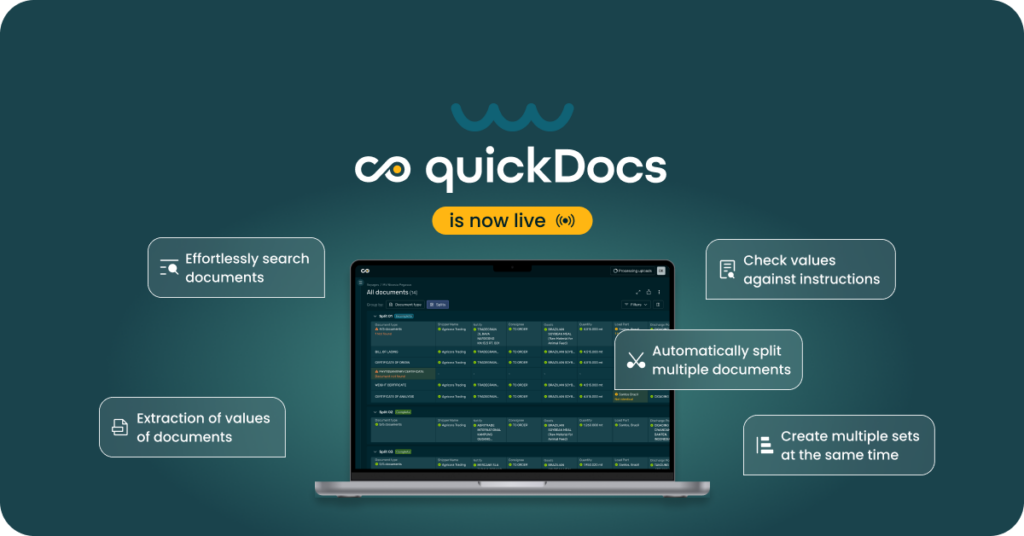
Geneva, Switzerland; 24th September 2025: Covantis, the digital leader in post-trade execution for agricultural commodities, today announced the launch of QuickDocs, an AI-powered solution that checks shipping documents against key trade requirements, including letters of credit, documentary instructions, and contracts.
Trading companies face two persistent challenges in document execution:
• Inefficient manual checks – Operations teams spend hours reviewing each document set, often under tight time pressure, which increases the risk of mistakes.
• Financial impact of errors – Every presentation with discrepancies can cost companies between USD 1,000–5,000 in additional working capital cost due to delayed payments, bank charges or penalties. For traders, this translates into hundreds of thousands of dollars of unnecessary financing costs.
QuickDocs directly addresses these challenges by automating document checks and surfacing discrepancies before submission. Its AI engine compares extracted values from bills of lading, certificates, and other documents against contractual requirements, helping companies deliver accurate documents presentations to banks and buyers.
“QuickDocs is our first production AI application solving real problems thanks to the massive leap and advancement of AI models. No matter the size of the company or industry, you are always confronted with the need to ensure that the documents you present to your buyer or bank are compliant with the requirements. QuickDocs does this in a few minutes, saving at least 75% in time, errors, or delays,” said Petya Sechanova, CEO of Covantis.
QuickDocs is part of the broader Covantis digital ecosystem, trusted by 75 global and regional trading firms and service providers. By streamlining document processes, increasing efficiency, and reducing risk, Covantis is shaping the future of digital trade execution in the agricultural industry.
About Covantis
Covantis was created with the aim to digitalize trade execution processes and bring efficiency to industry participants at all levels.
https://covantis.io/
Covantis is pleased to announce a significant milestone in the digital transformation of agri-trade execution. As of May 26, 2025, trading companies operating in the Brazilian market can begin using DocCreate, Covantis’ new solution for collaborative shipping documents creation.
In parallel, agents, fumigation and supervision companies are now being onboarded to the Voyages platform, enabling them to be appointed digitally and to participate directly in the execution process.
With this launch Covantis enables all key stakeholders in the shipping documentation workflow to collaborate seamlessly in a shared, digital environment.
Closing Gaps in Shipping Documentation
Traditionally, the drafting of shipping documents has been fragmented—spread across emails, spreadsheets, and disconnected systems. DocCreate addresses this challenge by providing a secure, structured environment for counterparties to draft shipping documents collaboratively.
DocCreate eliminates version control issues and reduces back-and-forth communications. Trading companies and their counterparties now have a central place to create drafts automatically based on the received Documentary Instructions, aligns on the data in the documents and move more efficiently toward documents presentation.
Expanding the Digital Network: Supervision Companies Join Covantis
In addition to launching DocCreate, Covantis is expanding the scope of its platform to include surveyor appointments and reports, updates organization. Trading companies can now appoint their supervision companies digitally, creating a more transparent and efficient coordination process. Additionally, supervision companies will be sending reports to their counterparties in a structured and automated manner.
Onboarding these service providers is a critical step towards a fully digital execution workflow. By enabling supervision firms to work directly on the Covantis platform, we reduce manual tasks and unlock greater value for all parties involved.
One Connected Workflow
This launch reflects Covantis’ commitment to delivering end-to-end digital solutions for agri-trade. With DocCreate and the Voyages platform now linked through a growing network of stakeholders, trading companies gain:
- A single platform to draft, coordinate, and execute shipping documents
- Improved efficiency, accuracy, and transparency in document workflows
- A scalable model that can extend across regions and counterparties
What This Means for the Market
This launch is not just a new feature set—it’s a foundation for smarter, faster, and more connected execution in the bulk agri export chain. By digitizing both collaboration and coordination, Covantis continues to remove friction from global trade operations.
We’re excited to bring these capabilities to the Brazilian market first, and look forward to release them globally.
To learn more about DocCreate and the Voyages platform see our Product Pages.

Press release
Geneva, Switzerland – 31st of March 2025
CircleOut, the industry’s leading platform for identifying and matching circles and washouts in physical commodity trading has reached a new milestone. In the month of March, the platform successfully netted 559.000 metric tons of contracts volume by identifying circles for May–July delivery period—marking this a new record for German Lower Rhein rapeseed meal market.
This achievement underscores the growing impact of CircleOut as a powerful efficiency driver across the Agri trading network. For May–July delivery period, platform participants have now closed on average 50.3% of their positions—demonstrating the value of early market alignment and willingness to collaborate. Key market participants have synchronically uploaded and updated contracts in Covantis CircleOut platform just before the algorithm identifies the circles and contracts to be netted.
“The benefits compound as the market changes to the digital process of automatically identifying Circles via Covantis platform. This new record in the Lower Rhein rapeseed meal market highlights the clear efficiency gains the platform brings to trading firms.” ,said Sorin Albeanu, Head of Commercial at Covantis. ”
With over 35 companies already part of the network and over 43 million metric tons of volume processed to date, CircleOut continues to solidify its position as the go-to platform for optimizing physical trade flows and netting positions in advance of the delivery.
About CircleOut
CircleOut is the digital platform that helps commodity traders identify circles and washouts across complex contract chains. By automatically identifying circles and netting positings, CircleOut reduces operational burden, improves capital efficiency, and unlocks collaboration across trading partners.
Press release
Geneva, Switzerland and Charleston, US, 5th of February 2025
Covantis is enhancing its value proposition with the launch of Covantis eBL powered by Secro, a solution that empowers companies to issue and exchange electronic bills of lading (eBL) alongside other electronic documents, and supports real-time collaboration between all stakeholders, connecting exporters, charterers, buyers, agents, vessel owners and banks in a secure ecosystem.
Covantis clients can now use electronic documents in the execution of contracts therefore speeding up the presentation process, reducing the risk of fraud and need of Letters of Indemnity, while improving efficiency for all parties involved in the trade.
This new documents presentation solution complements Covantis existing proposition that digitalizes the agri bulk commodities execution process by encompassing the creation, exchange, review and automated checking of shipping documents.
“As the legal framework evolved with UK law recognizing electronic documents, many Phytosanitary Certificates, Quality Certificates, and Certificates of Origin transitioned to digital formats. With many authorities now accepting electronic and digital documents for customs clearance, we partnered with Secro to introduce the Covantis eBL solution to the agri industry. We are confident that through this partnership we will once and for all make the change from paper to electronic a reality for the agri industry.
We made this choice based on Secro’s technology fit, straight forward and efficient legal approach to eBLs, speed of delivery and capacity to adapt to market needs, and also the team’s expertise. We are confident that through this partnership we will once and for all make the change from paper to electronic a reality for the Agri industry noted Petya Sechanova, CEO, Covantis SA”
“With Covantis, we have the ideal partner, sharing core values such as customer focus, a relentless drive for innovation, and deep industry expertise”, said Michele, Co-Founder and CEO of Secro Inc. “The result of our strategic alignment is a solution that delivers significant benefits to clients—enhancing operational efficiency through Covantis workflows and improving trade finance performance with Secro’s tokenized eBL. There is nothing like this in the trading and fintech space: our unique joint value proposition opens new horizons for the agri industry.”
About Covantis
Covantis is an advanced platform revolutionizing post-trade execution workflows that’s transforming how the world moves agricultural commodities. Founded by leading global trading companies in the agricultural sector, Covantis connects the industry on a single digital platform to streamline trade execution for grains, oilseeds, byproducts, sugar and vegetable oils.
The platform is used by over 55 global and regional forward-thinking agri trading firms, no matter the size – small or large. The company is trusted by players throughout the supply chain, including trading companies, exporters, FOB sellers, charterers and CFR buyers. It’s also used daily by surveyors, agents and others in the wider agri commodity ecosystem.
About Secro Inc
Secro lowers the cost and risk of commodity trading by digitizing documents of title in a compliant, robust, and user-friendly way. Exporters, importers, traders, logistics service providers, and financial institutions collaborate on Secro’s digital platform to create, manage, and exchange legally binding, globally recognized digital negotiable instruments, such as e-bills of lading.
Dozens of leading organizations across the oil and energy, agriculture, fertilizer, and chemical sectors trust Secro and its proprietary tokenization technology to eliminate trade friction, accelerate cash cycles, and enhance equity returns. Secro also offers shipowners and port agents a collaborative digital solution to streamline the documentary needs of charterers.
At Covantis, we’re excited to give a first look into an upcoming solution that’s set to advance the agri-commodity trading industry: “Covantis eBL powered by Secro.” We’re proud to announce that we have received approval from the International Group of P&I Clubs, a critical endorsement that ensures secure and compliant use in global trade.
This approval underscores the reliability of our approach to digital documentation and aligns with our vision to streamline, simplify, and secure the complex workflows of trade logistics. With “Covantis eBL powered by Secro,” we aim to redefine efficiency standards, taking another step toward a future of truly paperless trade.
Find more info: https://www.igpandi.org/article/ig-approved-electronic-bill-of-lading-systems/
What’s Ahead? This new approval from the International Group marks a foundational milestone, one that assures our clients that they can transition to electronic documentation with confidence. Designed with industry standards and global compliance at its core, this upcoming feature will support our mission to make trade faster, safer, and more reliable.
Stay tuned for more details as we prepare to launch this exciting innovation in trade documents presentation!
Subscribe to our newsletter
Get the latest industry news. See where we go next!