4 August 2026
Digitalisation and the Move from Paper to Electronic Documents in Global Trade
Paper has been the default in trade execution for decades. Bills of Lading, certificates, and other key trade documents have traditionally moved across sellers and buyers, banks, vessel owners, agents and authorities through couriers and manual handover.
At the Gafta seminar “The Agri Digital Era”, held in Geneva on May 11, industry leaders from trade, shipping, law firms and industry associations came together to discuss what it will take to move from paper to electronic documents.
The message was clear: digitalisation is no longer a future ambition. It is already happening but scaling it across the industry will require legal recognition, standards, collaboration, and practical adoption across the full trade chain.
The foundations: legal, standards, and human confidence
Pamela Mar, Managing Director at ICC Digital Standards Initiative, opened the discussion by framing the challenge clearly:
“When we look at what we have to do to move from analogue to digital, there are basically three problems to master: make it legal, simplify standards, and build human confidence.”
Legal progress is accelerating rapidly. Pamela highlighted that 62.5% of global exports now come from economies that are aligned with or publicly committed to aligning with the UNCITRAL Model Law on Electronic Transferable Records (MLETR), up from just 34% two and a half years ago. She also noted that this figure could reach 80% by 2028 as more jurisdictions align with global trade agreements and model laws supporting paperless trade.
This is critical because electronic documents need the same legal recognition as paper to be trusted and widely used. Michael Buisset, Partner at HFW, explained that English law historically required possession of an original hard-copy Bill of Lading, making eBL adoption difficult. The UK Electronic Trade Documents Act 2023 changed this by allowing electronic trade documents to be possessed, endorsed, transferred, and treated like paper equivalents.
Standards are just as important. ICC DSI has already mapped 36 key trade documents, with 21 now digitized and linked to clear data standards. This work is being translated into practical tools, including the Key Trade Documents and Data Elements framework, the Bank Defined Dataset, and implementation guides that map data standards across trade documents so developers and institutions can interoperate between different systems.
Pamela also warned that asking every stakeholder to join a different platform creates “digital islands”: trusted systems that work in isolation but are hard to scale across trading partners. Instead of another super-platform, she pointed to trusted trade records supported by common standards, digital identity, and trust frameworks.
Adoption is happening, but unevenly
Grant Hunter, Chief Digital Officer at BIMCO, shared important lessons from other commodity sectors, particularly dry bulk shipping. He highlighted that Electronic Bills of Lading are no longer just pilots. In iron ore, adoption has reached significant levels, showing that digital trade documentation can work in real commercial flows.
BIMCO’s “25 by 25” campaign, launched with major mining companies including Rio Tinto, Vale, BHP and Anglo American, aimed to move 25% of iron ore shipments to eBLs within two years. The target was reached ahead of schedule in late 2024 and now represents an estimated 40% adoption rate in the iron ore trade.
Grant also made an important point on measurement: in bulk shipping, adoption should not be judged only by the number of bills issued. Unlike containers, bulk trades often involve fewer documents, but much larger cargoes, so the more relevant measure is the value and volume of commodity moving electronically.
One reason BIMCO started with the CONGENBILL format is familiarity. Its eBL standard mirrors a widely used dry bulk paper Bill of Lading, uses a structured dataset of around 20 core fields, and is aligned with UN/CEFACT while being prepared for ISO 5909. The goal is to reduce resistance by making the digital version feel operationally familiar, not like a completely new process.
“It’s not the technology or the legal aspects where we get the most resistance. It’s people moving from a paper world to a digital world.”
Why speed matters in trade execution
From the trading perspective, Salvatore Castellano, Freight Decarbonisation Manager at COFCO International brought the conversation back to operational reality. Trade moves fast, and documentation needs to keep up.
“The speed of information transfer is key to success or failure. If we can secure a deal but cannot provide the documents with the same speed, a good deal can turn into a bad deal.”
Physical documents can be delayed, misplaced, amended, couriered, and reissued, creating manual work, additional cost, and unnecessary risk in markets where timing directly affects execution, payments, working capital, and customer experience.
Covantis’ Perspective: Making Electronic Documents a Reality
Covantis’ session brought the discussion back to the practical question facing the industry: how do we move electronic documents from pilot projects to everyday trade execution?
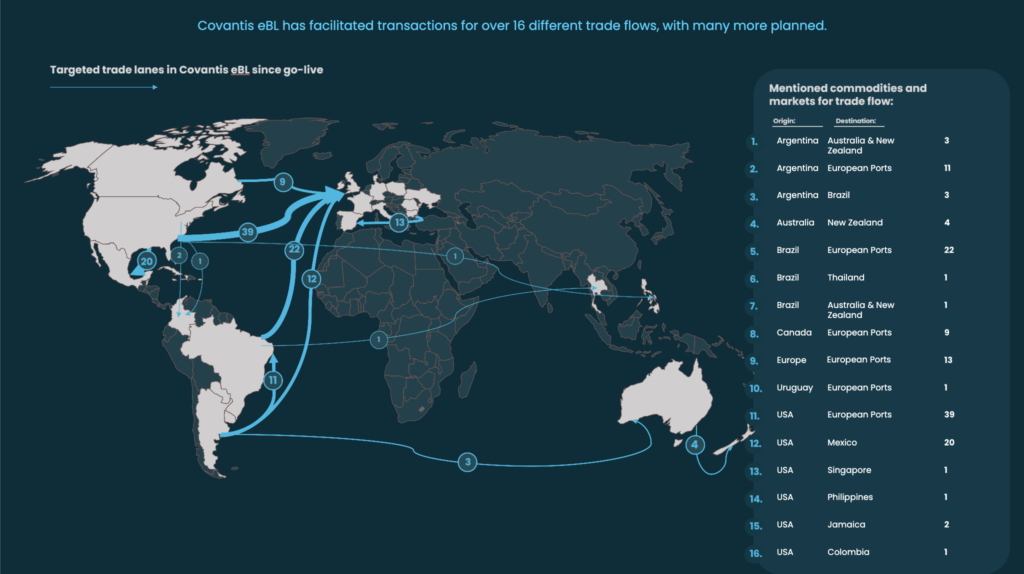
Petya Sechanova, CEO of Covantis, shared that since launching Covantis’ agri-focused eBL solution in January 2025, the platform has digitalised 7 million metric tons of eBL volume across more than 16 trade flows. In just one year, Covantis has also processed over 300 eBLs and onboarded more than 200 legal entities. While eBL usage in bulk agri trade still represents only around 1–2% of global shipped volumes, and 5% of the overall volume executed in Covantis main platform Voyages, this marks a significant step forward from near-zero adoption just two years ago. Today, more than 80% of current eBL flows are moving into Europe, where favourable legislation and fewer phytosanitary barriers have made adoption easier.
“We are not only providing an eBL solution, we are digitalizing the entire documents process, from documentary instructions to document creation, checks and electronic presentation.”
Covantis eBL solution enables companies to issue, release, endorse, transfer, present, reissue, and, where needed, convert electronic Bills of Lading to paper within a secure digital ecosystem. The platform connects exporters, charterers, buyers, agents, and vessel owners, allowing them to collaborate and exchange eBLs alongside other electronic shipping documents. This helps reduce document travel time, courier dependency, LOI exposure, fraud risk, and payment delays.
Covantis eBL has facilitated transactions for multiple trade lanes, with a few examples mentioned below:
The path forward is practical: start with repeatable flows where eBLs solve real pain, bring trusted counterparties into the process, include the right clauses upfront, and build confidence through proven cases until electronic documents become the industry standard.
Scaling trade execution: speed, finance, trust
Digitalisation is not only about efficiency. It improves control and visibility; reduces risk and the need for Letters of Indemnity to be issued when documents are delayed and the cargo needs to be discharged. It can also help market participants scale their operation without adding more manual workload.
Sorin Albeanu, Head of Commercial at Covantis, pointed to the trade finance opportunity:
“Trading firms can trade more with the same capital as the payment cycle becomes faster and banks recognise electronic documents as collateral.”
Faster document presentation due to electronification can support faster payments and lower working capital cost, but also new financing possibilities. With banks recognizing the eBL as collateral, the financing rates should become more competitive as they have more control over the operation.
Stefanie Gummelt, Director for Global Trade Execution at ADM, reinforced the operational case. Paper-based processes are slow, error-prone, and create friction, while electronic documents can improve accuracy, visibility, risk management, compliance, and payment cycles. At the same time, adoption still depends on confidence.
“Do not take the first ‘no’ as a final barrier. Often it is not because people do not want to change; it is because they need time to understand the process.”
Stefanie also pointed to the importance of secure, traceable, and auditable digital records in building greater confidence around document integrity. Reliable digital records increase compliance, reduce fraud risk, and improve transparency as regulatory expectations continue to evolve.
ADM has already made significant progress in adopting electronic Bills of Lading, using them across multiple trade lanes. The company initially focused on internal flows before expanding into broader trading activities, including transactions under cash-against-documents payment terms. However, Stefanie noted that adoption remains uneven across regions and counterparties. While momentum is growing, the industry is still in a transitional phase, and ADM’s approach has been to align contracts, processes, and stakeholders to create the conditions needed for broader adoption.
Beyond eBL: the full document ecosystem
The seminar also looked beyond eBLs. Rose Souza Richards from the International Seed Federation ration discussed electronic phytosanitary certificates and the importance of public-private collaboration in making digital processes work across borders.
Today, more than 130 countries are connected to the International Plant Protection Convention’s ePhyto system at different stages of adoption, ranging from testing to full exchange. ePhyto adoption accelerated during COVID-19, when physical document handover became difficult at borders. Rose explained that some paper phytosanitary replacement processes can still take up to 30 days, creating major risks for time-sensitive agricultural products.
Her point applies far beyond ePhyto. Governments can create frameworks, but companies moving goods every day need to be part of the process. They understand the operational reality, the bottlenecks, the country-specific challenges, and the documents required across different flows. The future of digital trade is about building a connected document lifecycle, where instructions, drafts, checks, certificates, BLs, presentations, and payments can move more efficiently and securely. At ISF, we are seeing encouraging progress in ePhyto adoption, particularly in Brazil, while work continues to ensure that in the future we will have new markets, such as Turkey added to the ePhyto network.